
Leveling the Playing Field: Addressing Diversity, Equity, and Inclusion (DEI) at IPA Peru
Published:
By Ronny M. Condor, Sergio De Marco, Juan Manuel Hernández-Agramonte, Kelly Montaño, and Jessica Tollette
Note: This post was originally published on the Innovations for Poverty Action (IPA) website. As the original page is no longer available, it is reproduced here in its entirety to preserve access to its content.
Making Diversity, Equity, and Inclusion Local
In a recent post we discussed that only 27 percent of researchers in the IPA network are from low- and middle-income countries (LMICs). Increasing the representation of LMIC researchers is needed to make more inclusive research communities. In this post, we want to go a step further: to promote diversity, equity, and inclusion (DEI) globally we need to understand what it means in the different local contexts in which IPA works.
As a global organization, meeting our DEI commitment requires an understanding of how exclusion and discrimination work in both global and local research communities, and the appropriate actions to address them. It also requires coordination and commitment among different teams within the organization at every level. In this post, we describe the first steps that our Country Office in Peru has taken to understand and address DEI needs and help promote our workforce diversity in-country.
Knowing the Context
Peru is a land of great cultural and ethnic diversity, with 48 languages spoken across coastal, jungle, and highland areas. That also means there are many cues about people which could lead to discrimination — factors like surname, skin color, appearance, language, accent, or socioeconomic background.
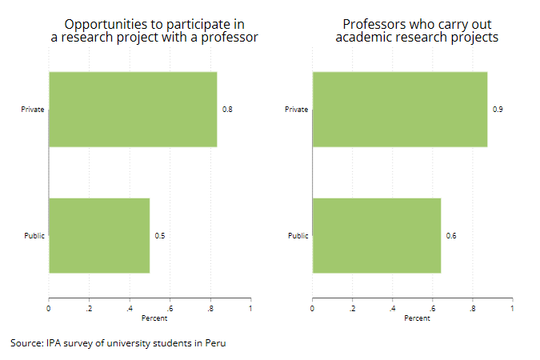
To understand exclusion in our workforce, the IPA Peru team reviewed relevant research and ran a quick context assessment involving a series of surveys and qualitative interviews of IPA Peru staff and university students. One indicator we found that explains the opportunities and constraints job candidates in the research market face is the type of university where they studied. In our survey, students from public universities reported a lower probability of having professors involved in research projects, and fewer opportunities to work on research projects with a professor.1
Figure 1: Research environment by type of university
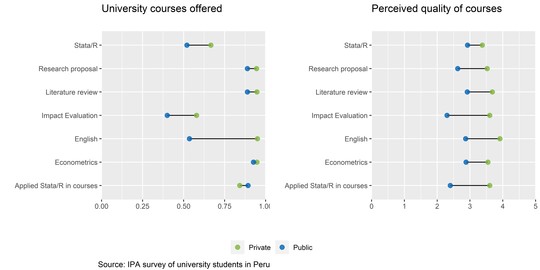
We also asked students to report whether their universities offered courses on the content and skills that we look for when hiring staff, and their perception of the quality of those courses.2 Figure 2 shows that private universities have a higher probability of offering courses of greater quality on content and skills that IPA seeks during the selection process.
Figure 2: Offered courses and perceived quality by type of university
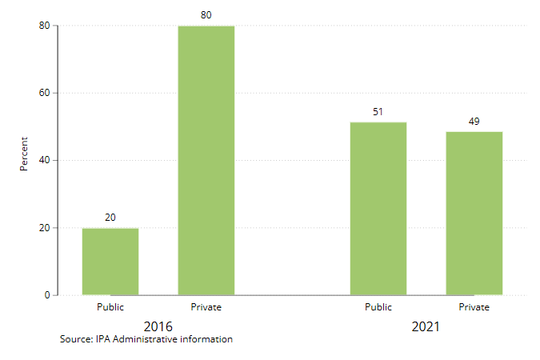
This lack of (quality) resources and opportunities that students from universities with less research activity have translates into less information on how to navigate the research and academic job market, absence of networks that provide access to opportunities and support in the application process, and fewer opportunities to develop entry-level research skills. Given that students from public universities and those outside Lima usually come from lower socio-economic and/or indigenous backgrounds, the result is an underrepresentation of these groups in the research community. At IPA Peru, we found that in 2016, most of our applications came from private elite universities and only 20% of our staff came from public universities.
Leveling the Playing Field
Based on our context analysis, we launched a series of initiatives to tackle some of the barriers that underrepresented job candidates face.
Information outreach: We held a series of presentations at public universities. The goal was to talk with students about IPA’s work, the role of evidence-informed policy, the skills needed to work at IPA (and similar organizations), and the investments students should make early in their studies to eventually work at such organizations. We also discussed job opportunities and professional careers at IPA.
Paid internship program: We addressed the lack of opportunities to engage in research early in their career by launching a paid internship program aimed at candidates from public universities. This meant that if students weren’t getting hands-on research training at their university they could get it at our office.
Role models: We had IPA staff from underrepresented groups join the presentations to discuss the application process and their experience with IPA. This served two purposes: offering (1) relevant information and (2) role models for potential candidates.
These initiatives were all relatively low-cost, but allowed us to level the composition of our staff, increasing the proportion of staff from public universities to 51% (Figure 3). The mechanisms that helped achieve this change were an increase of applicants and interns from less privileged backgrounds and the creation of networks between staff from underrepresented groups and prospective candidates. These networks allowed for the sharing of internal information (e.g. “hidden curriculum”) and advice on how to navigate the research labor market.
Figure 3: Proportion of public university graduates in IPA Peru country office
Best Practices
This first success showed that with small, low-cost changes to our processes we could help level the playing field for underrepresented groups. Below are some of our best practices:
Understand your context: Use quick assessments based on administrative data, online surveys, and interviews/focus groups to understand the status of your workforce, and the opportunities and constraints that job candidates face.
Devise low-cost strategies: There is much we can achieve by making small changes to our processes. For example, should you use online channels only to disseminate job opportunities? Should you provide advice on how to prepare for the selection process?
Involve your team: When we shared our plan to address DEI with our staff, we found they were willing to volunteer time to address the status quo. They also shared invaluable insights and proposed actions based on their own experiences.
Monitor DEI and learn: We incorporated DEI indicators to assess our recruitment process. For example, we are maintaining a database of applicants and noting the share coming from underrepresented groups to help us adjust and improve our DEI strategy as we go.
Build partnerships: We are part of a research community that includes other organizations with similar goals, and we have launched joint initiatives such as webinars and trainings for job applicants to cover more ground together.
IPA Peru is continuing its DEI journey; providing information and offering opportunities to underrepresented candidates is just the first step. We look forward to sharing next steps, including addressing skills gaps. In the meantime, learn more about IPA’s DEI commitment.
If you would like to contact IPA’s DEI working group, please reach out at ipa_diversity@poverty-action.org.
The National Regulator for Higher Education in Peru — SUNEDU (2020) reports a similar situation for universities outside Lima in their biannual report on higher education situation in Peru. ↩
Courses included: Courses on how to use R or Stata, courses on how to prepare a research proposal and conduct literature review, courses on impact evaluation, English courses, Econometrics, and courses that require using R or Stata. ↩